Monday, 5 May 2014

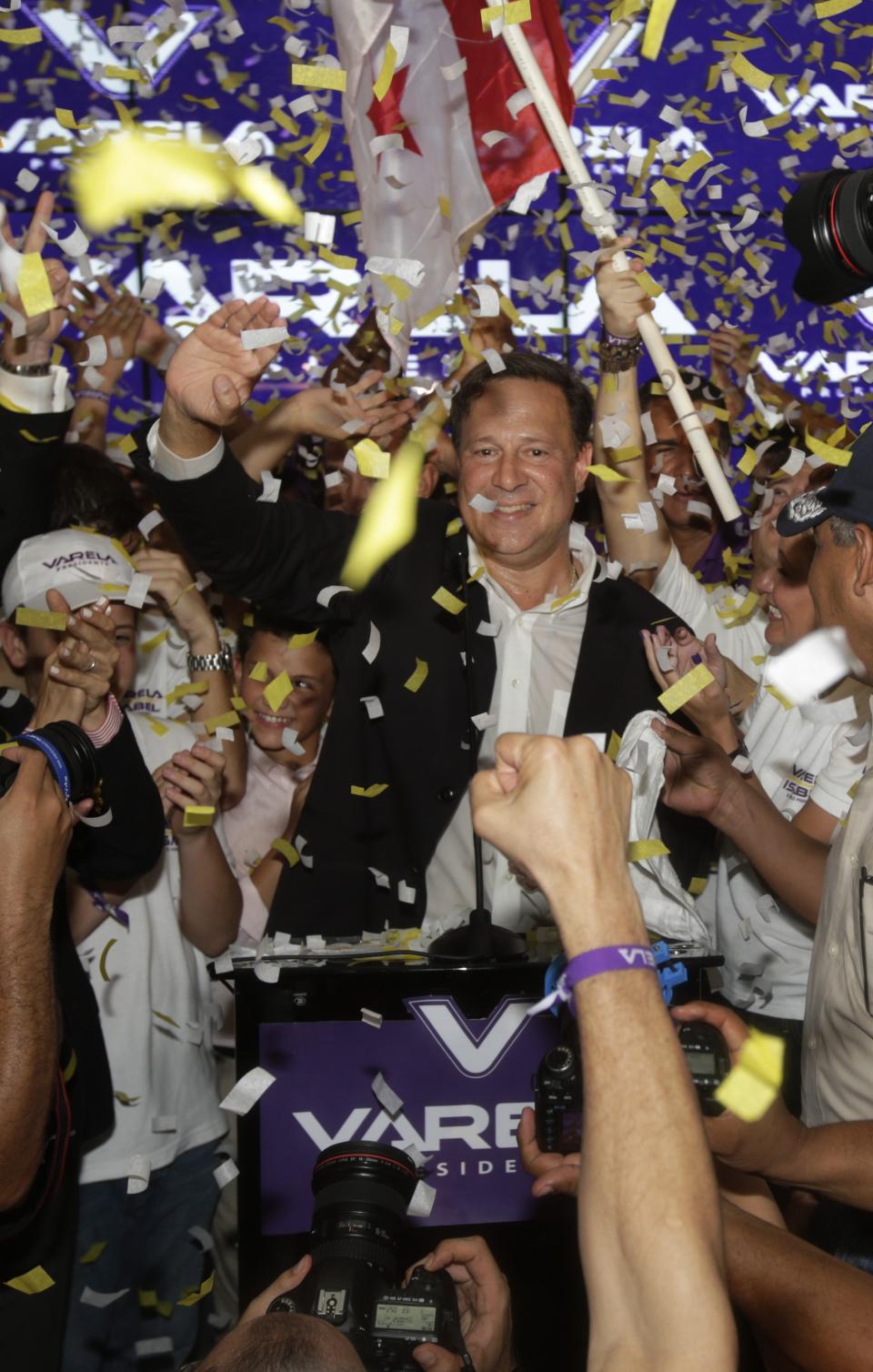
We have a winner in Panama

Arnulfo Franco
Vice President Juan Carlos Varela won yesterday's presidential elections in Panama with 39 percent of the votes. President Ricardo Martinelli's preferred successor, Jose Domingo Arias, who ran with Martinelli's wife as his vice presidential candidate took home 32 percent. Finally, Juan Carlos Navarro, a former mayor of the capital, followed a close third with 28 percent.

Panama continues its post-Noriega tradition in throwing out the incumbent party although, unlike Guatemala, the former governing party does not necessarily disappear.

Boz has his always enjoyable post-election takes with Five Points on Varela. President Martinelli and soon-to-be president Varela trades jabs against each other yesterday with Martinelli saying "May God help us" and Varela offering his "Whoever wants to do business should grab their things and go to the private sector."

Greg also has a look at Panama's Election and notes that 
The basics of post-invasion Panamanian presidential politics have held. The incumbent party loses while power is shared within a small oligarchy (we are seeing a switch from big supermarket money to big rum money). Poverty and inequality are serious problems but economic growth is solid (very high recently) and the left has difficulty getting much of a foothold. Illicit money will keep flowing in to be laundered and corruption won't go anywhere in particular even while all the parties point fingers at each other and simultaneously skim what they can. Presidents get greedy and want another consecutive term but are rebuffed.
The Economist has many of the same points that Boz and Greg have - another election, another incumbent party candidate defeated; a relatively surprising victory for Varela, strong growth but ongoing problems with poverty and inequality; personality differences among the candidates but lack of programmatic differences.

There was a lot of party switching in the last congress and Varela is going to hope that continues into the next legislative term. His party, the Panameñista Party, will only control 11 out of 71 seats. There's likely to be some bumps ahead for the new president once the canal expansion, the Metro, and a number of other initiatives that have been driving economic growth are completed. The canal expansion should see nice returns but it is unclear how economically sound the Metro will be. Martinelli has weakened the country's political institutions these last five years, especially the Supreme Court. Corruption investigations into President Martinelli in Panama and abroad will likely continue as well.

Fortunately, Varela seems to have things in perspective. One of his first priorities as president will be to re-establish ties with Venezuela (!).

Saturday, 3 May 2014

Bananas, seeds and gold courses in Central America

So how is international pressure impacting the Guatemalan banana industry? Fresh Fruit Portal has a pretty balanced (accurate?) overview of the situation in Guatemala.
With pressure from bodies such as the International Labor Organization (ILO), Guatemala’s attorney general has given greater attention to Sitrabi’s cases.
Russell said much of the investigative interest has stemmed from fear of an ILO-led commission of inquiry that could bring greater grievances to light.
On a recent visit to the attorney general’s office, Russell said representatives were quick to highlight their progress on cases emphasized by the ILO.
“For as long as that pressure is there, we think that’s a potential engine for influencing change. Unfortunately it’s still on the table. It will be discussed by the ILO governing body in November. It’s a hanging threat that the government there is aware of,” Russell said.
“They realize if there were a commission of inquiry, a lot of things would be uncovered that they are currently managing to keep hidden. This might have a knock on effect to their free trade relationships with the States and the EU.”
In particular, Guatemala’s union situation has been flagged under the Dominican Republic-Central America-United States Free Trade Agreement (CAFTA-DR).
Under pressure from the ILO, the validity of the U.S. free trade agreement with Guatemala was put into doubt in 2008. The labor body has questioned Guatemala’s perceived lack of labor policy enforcement, which could violate certain articles of CAFTA-DR.
In its first labor claim using a free trade agreement, the U.S. challenged Guatemalan practices in 2011 by requesting a panel to improve enforcement.
 There's nothing wrong with creating jobs in Central America, Clay Aiken.

No love for Monsanto here - looking for a solution to El Salvador's seed program's lack of compliance with CAFTA-DR and even national laws.
Perhaps the MAG’s seed distribution program violates the Central American Free Trade Agreement, but that does not make it a bad program. It is just another reason why CAFTA and free trade are bad policies. 
And really, does anyone really think that it is a good idea to spend needed development assistance on luxury condos and golf courses in El Salvador?

Thursday, 1 May 2014

Gearing up for Sunday's election in Panama

The World Politics Review conducted an interview with Orlando Perez about this weekend's elections in Panama.
WPR: What are the major domestic issues at stake in Panama's presidential election?
Orlando J. Pérez: The electoral campaign has been framed around the dynamic of continuity versus change. The government has touted social spending, infrastructure investments and economic growth. The government candidate, Jose Domingo Arias, has campaigned on continuing and expanding President Ricardo Martinelli’s populist policies. The government has spent a significant amount of money on publicity promoting its infrastructure projects, such as a new urban subway system. And it has sought to scare voters about the potential of the opposition reducing—or ending—social programs. 
The opposition has focused on corruption and the president's authoritarian style. Martinelli has been embroiled in several corruption cases involving kickbacks from foreign companies investing in Panama. Politically, Martinelli has sought to dominate the judicial and legislative branches by packing the courts and luring opposition legislators to his coalition with the promise of government investment in their districts. 
Panama's constitution prohibits immediate presidential re-election. However, the nomination of the first lady, Marta Linares de Martinelli, as the vice presidential candidate on the government party's ticket has been seen as a clear sign of the president's desire to remain influential after the elections. Given the likelihood of a very close election, a key question is the extent to which the independence of the Electoral Tribunal will be respected and the outcome accepted by all candidates.
Go read the entire interview (if you are blocked, go though a social media link). You can also read Orlando's guest post on this site from September 2013 when he spoke about many of the ways that Panama has changed over the last two decades.