Friday, 3 October 2014

An order was delivered to remove the protesters “dead or alive.”

Prensa Libre
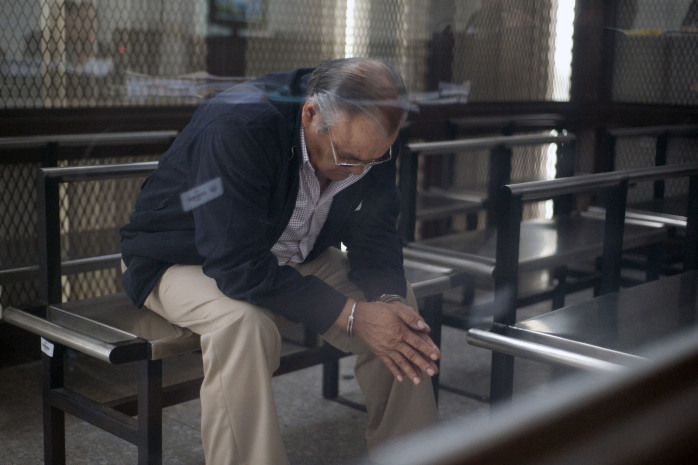
On day two of the Spanish Embassy massacre, the court hear testimony from witnesses that support the prosecution's case against Pedro García Arredondo.

 César Escalante served as a chauffeur for then-Spanish Ambassador Máximo Cajal.
“Police officers called another officer who was in the street and told him to dump [fuel] inside the building, and another said that no one should be left alive,” Escalante said. The witness said that when he tried to stop police from setting the fire, they assaulted him.
... 
Escalante said he remained outside the embassy and witnessed police attacking the Spanish ambassador as he attempted to escape the fire. Cajal and Gregorio Yujá were the only two survivors from inside the building, but Yujá was later kidnapped from the hospital and murdered. His body was dumped on the lawn at the University of San Carlos.
Other witnesses, including former Interior Ministry spokesman Elías Barahona, who arrived to the courtroom in a wheelchair, admitted to overhearing a conversation between then-Interior Minister Donaldo Álvarez and National Police Director Germán Chupina where an order was delivered to remove the protesters “dead or alive.”
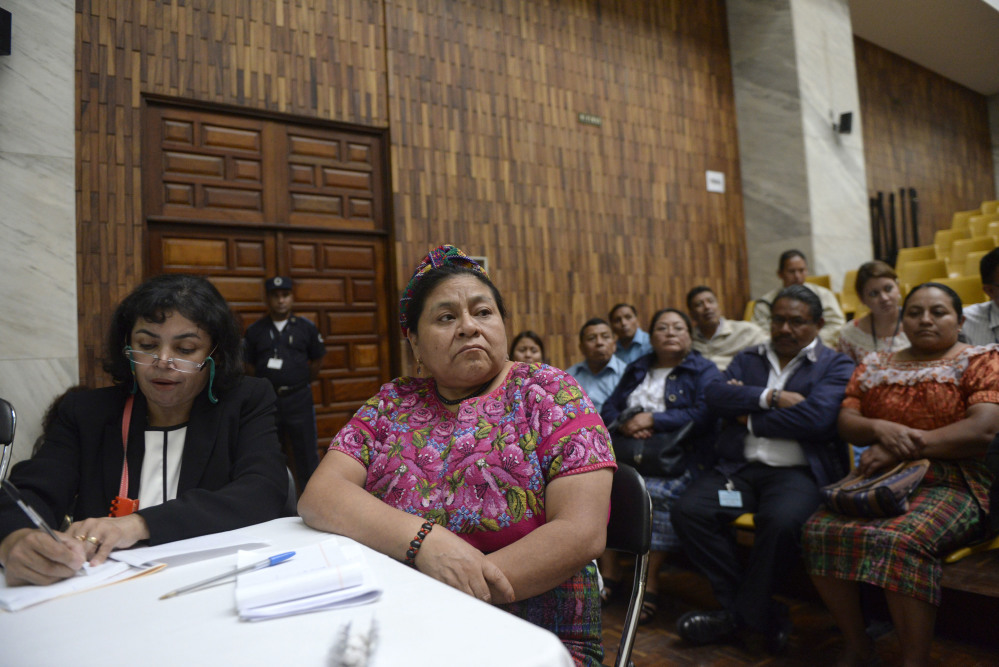
Guatemala remains a country of contrasts
Guatemala is a country built on contrasts: ancient to modern; unbelievably wealthy to vastly poor; downpours of rain to warm sunshine; an Indian majority and a Spanish ruling minority; a large German population to astonishing numbers of European tourists; and diverse languages, with Spanish as the official language. 
There's such injustice in the aborted prosecution of Efrain Rios Montt yet hope for justice in the trial of García less than two years later.

Thursday, 2 October 2014

WOLA is busy tackling the Northern Triangle

I just finished an article for the World Politics review on the rule of law in Central America and am now tackling some Freedom House reports for the region so I'll just link to some reports by Geoff Thale and the Washington Office on Latin America.

First, they lay out 12 Principles to Assess the Plan of the Alliance for Prosperity in the Northern Triangle.

  1. Ensure that the plan’s strategies are comprehensive and coordinated within each country. 
  2. Governments must show institutional commitment to full implementation. 
  3. Focus on institutional reforms that will improve the daily life of citizens in Central America.
  4. Strengthen transparency and fight corruption. 
  5. Build capacity and accountability for the judiciary and public prosecutors, and protect witnesses in sensitive cases. 
  6. Support evidence-based, community-level violence prevention. 
  7. Target employment training and job creation programs to communities where youth are especially at risk and from where many young people are migrating. 
  8. Emphasize fiscal reform and the long-term sustainability of programs.
  9. Recognize that different countries require different approaches. 
  10. Avoid any plan that is too narrowly targeted on only one element of the problem. 
  11. Evaluate successes and failures.
  12. Ensure that the plan includes mechanisms for effective donor coordination.
The alleged plan is now down from the internet (found it again) but you can read a description here. It looks like the Northern Triangle wants the US to pay for its infrastructure projects. While the US is in someways the only one with the money for such a billion (multibillion?) dollar investment, I'm not sure that's what we were hoping for. Call me crazy but I don't foresee any big changes in US policy towards / support for Central America anytime soon. We'll just keep muddling along. 

Then there's also Migration and Citizen Security in El Salvador from Geoff and WOLA. They mostly describe the recent report from the UCA on citizen security under Funes.
But most interesting was the study’s critique of how public security policy was handled over the course of the last five years, under the government of left-of-center President Mauricio Funes. Initially, the administration, installed in 2009, turned away from the “mano dura” policies of its predecessors on the political right, and focused on institutional changes to make the police a more honest and effective force that would both capture criminals and deter crime. New leadership was named, the investigative unit was reorganized, and an anti-corruption campaign was launched. But a backlash from hardliners and only modest drops in the homicide rate led the President to radically shift strategies. He moved the Minister of Defense over to the Public Security Ministry, and military or military-linked officials were soon named to key posts in police investigation, police intelligence, and at the head of the police. The anti-corruption campaign stalled, and officials who had been under suspicion were soon rehabilitated.  The number of army troops assigned to patrol the streets soared. And individuals linked to the government brokered a pact between the country’s two main street gangs that prohibited killings of rival gang members, while gangs continued to engage in extortion and other criminal activity.  
The UCA’s critique focuses on the administration’s shift away from institutional reform and its turn toward military involvement in policing. The report ends by calling on the new administration, which took office in June, to renew the focus on police reform, strengthen the commitment to a civilian-run police force, and invest more in community-based violence prevention efforts. 
Finally, Geoff and WOLA have The MCC Announcement in El Salvador: What It Says about U.S. Assistance to El Salvador and the Region. They are certainly much more positive that the Wall Street Journal's Mary Anastasio O'Grady who came out swinging with American Aid Props Up a Castro Ally. I have my concerns about El Salvador and the second MCC Compact but she's just silly.

On the positive side, she only mentioned Hugo Chavez's name one. 

Wednesday, 1 October 2014

Trial in Spanish Embassy massacre begins in Guatemala


A trial opens this morning in Guatemala City against Pedro García Arredondo. The former police chief is accused of having ordered the massacre at the Spanish Embassy in 1980. Thirty-seven people, including Rigoberta Menchú's father, Vicente Menchú, died in a fire allegedly begun by the security forces.
Soldiers and police set fire to the embassy with the protesters inside, killing 37 people – most of them indigenous Mayans. Human rights groups called the attack one of the worst atrocities committed by the armed forces during the civil war, which lasted from 1960-1996. More than 200,000 people were killed or disappeared during the war, according to the United Nations.
Spanish Consul Jaime Ruiz del Árbol also was killed in the embassy attack, along with Guatemala’s former Vice President Eduardo Cáceres and former Foreign Minister Adolfo Molina.
“We want them to give us the opportunity to close a chapter that’s been open for 34 years, because I’m completely convinced that if we don’t close the open wounds that thousands of Guatemalans still have, it will be difficult to create peace,” said Menchú, a plaintiff in the case.
The only person to survive the embassy fire and its aftermath was then-Ambassador Máximo Cajal, from Spain. An indigenous protester survived the fire, but was later kidnapped from the hospital and murdered. His body was dumped on the campus of the San Carlos University.
Cajal died last April, but his testimony in the case has been documented in order to present it at trial, Menchú said.
García is already serving a seventy-year sentence for enforced disappearance and crimes against humanity in the 1981 disappearance of Édgar Enrique Sáenz Calito.

Honestly, I haven't followed the details of the case but I don't know how they are going to convict the former police chief unless there's a paper trail, Protesters occupied the Embassy on January 30th. Instead of negotiating with the protesters, Guatemalan forces entered the Embassy. During the siege, a fire began which led to the thirty-seven deaths. Some claim that the protesters' molotov cocktails were ignited during the siege which led to the deaths but I'm not sure there's hard evidence for that scenario or for a different scenario in which the security forces were more directly involved in starting the fire.

The security forces on the scene do not seem to have made any effort to allow the protesters to escape the building but instead refused to allow the firemen to extinguish the blaze and to enter the building. This is where it appears that García comes into play. Knowing / believing that security forces were to blame is different from proving it.